


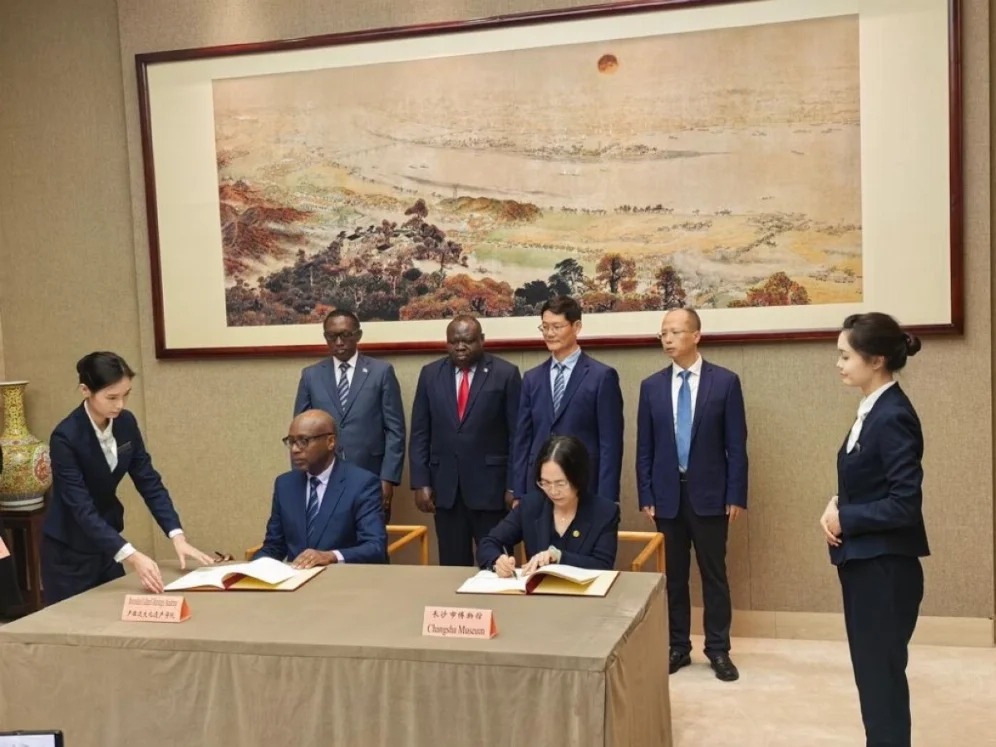
The agreements were signed on Sunday, October 25, 2026, in Changsha, the capital of China’s Hunan province, during a visit by Christophe Bazivamo, Secretary-General of Rwanda’s ruling Rwandan Patriotic Front (RPF-Inkotanyi).
One of the agreements was signed between the Changsha Museum and the Rwanda Cultural Heritage Academy (RCHA), represented by its chairperson, Ambassador Robert Masozera.
The partnership aims to bring the two institutions closer together through cooperation in cultural heritage preservation and the sharing of knowledge and experience.
The second agreement brought together Rwanda Polytechnic (RP) and Changsha Vocational and Technical College. Rwanda Polytechnic was represented by its Director-General, Sylvie Mucyo.
Through this partnership, the two institutions hope to strengthen technical and vocational education, helping students gain practical skills that can prepare them for the job market.
Beyond the signing of the agreements, Bazivamo held talks with officials from Hunan province on ways to expand cooperation between cities in Rwanda and China.
The discussions focused on building stronger ties between Kigali and Changsha, as well as between Rwanda’s Muhanga district and the Chinese city of Loudi.
Both sides explored opportunities to work together in trade, investment, agriculture, technology and education, among other sectors.
The visit also highlighted the political relationship between the two countries.
Bazivamo arrived in China on Thursday, October 22, and held discussions with Liu Haixing, head of the International Department of the Communist Party of China (CPC) Central Committee.
Their talks focused on strengthening cooperation between the CPC and RPF-Inkotanyi, particularly in leadership training, research and the preservation of cultural heritage.
Bazivamo also visited the Party School of the CPC Central Committee, where he met its vice-president to discuss opportunities for cooperation in training, research and development.
The agreements come as Rwanda and China continue to expand their relationship into areas that could directly benefit their people.
For Rwanda, stronger cooperation in vocational education could help young people develop skills needed in a changing job market, while cultural exchanges could create opportunities to preserve and promote the country’s heritage.
The discussions on trade, investment and technology also point to a broader ambition by both countries to turn their longstanding relationship into practical partnerships that support economic growth and development.