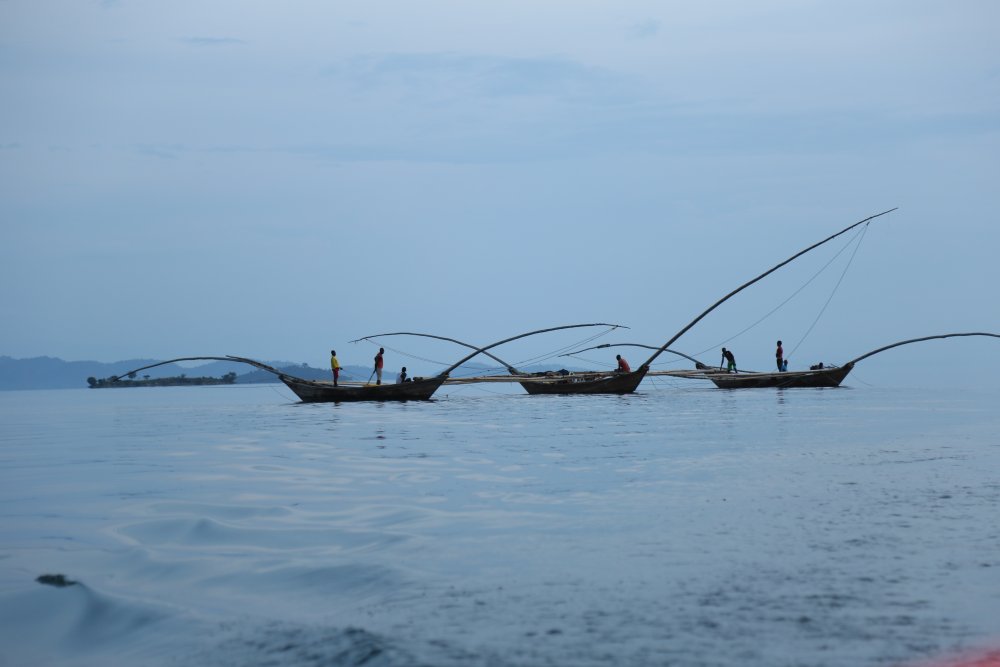


But the recovery is facing a familiar threat.
More than 10 illegal fishermen, locally known as rushimusi, were arrested in Nyamasheke District during the fishing ban, while more than 100 illegal nets were seized, according to Gérard Mugenzi, head of the Federation of Fishermen’s Cooperatives in the district.
Mugenzi said the crackdown helped protect sardines while the lake was closed, contributing to the increase in catches recorded after fishing resumed.
“More than 10 people were arrested and handed over to the authorities for education,” he said.
Yet keeping illegal fishermen off the lake has not been easy.
Patrol teams use boats carrying five people, while suspected poachers can quickly scatter or escape when they see them approaching.
“Some of the poachers escaped because it was not easy to catch many of them. But we arrested more than 10 and seized more than 100 nets,” Mugenzi said.
The concern goes beyond fishing during the two-month closure. Some fishermen use nets that catch young sardines before they have had a chance to grow or reproduce.
Among the equipment seized were Kaningini and ibipurizo nets, which can trap young fish.
Mugenzi also warned about nets made from supaneti, a synthetic fabric that can sweep up fish eggs and young sardines and damage breeding areas.
“Some fishermen enter the bays where sardines reproduce and catch the young fish. This damages production,” he said.
Other fishermen use Gacimba nets, which can also catch young sardines.
A struggle that has lasted years
Illegal fishing is not a new problem on Lake Kivu.
In 2013, more than 20 illegal fishermen were arrested during inspections in Karongi, Rutsiro and Nyamasheke. Authorities also seized 39 illegal nets and six boats.
A year later, a larger operation across districts bordering the lake led to the arrest of 517 illegal fishermen, including 66 from Nyamasheke. Officials also seized 118 Kaningini nets, 63 boats and other prohibited fishing equipment.
Rwanda’s agriculture and livestock development agency, RAB, requires fishing on Lake Kivu to stop for two months to give sardines time to reproduce.
But for some fishermen, the temptation to keep working remains strong, particularly because sardines are in demand in local markets.
Bigger catches bring new hope
When fishing resumed in Nyamasheke after the latest closure, fishermen saw an immediate difference.
On the first night, they caught 15 tonnes and 33 kilograms of sardines — more than the 12 tonnes recorded during the same period the previous year.
For Samuel Nzakizwanayo, a fisherman with COOBOPELAKI cooperative, the change was personal.
Before the lake was closed, he said, he would sometimes return home with only about three kilograms of fish after a night on the water.
After fishing resumed, his catch rose to more than 20 kilograms in one night.
Some fishing groups saw an even bigger difference. According to Nzakizwanayo, groups that previously struggled to catch four kilograms were now bringing in 100 kilograms or more.
The Federation of Fishermen’s Cooperatives in Nyamasheke has seven cooperatives representing about 400 members.
For these fishermen, the bigger catches mean more than improved statistics. They mean more fish to sell, more income for families and renewed hope that Lake Kivu can continue supporting the communities that depend on it.
But protecting that progress will depend on keeping illegal fishing under control — especially practices that remove young sardines before they can reproduce.