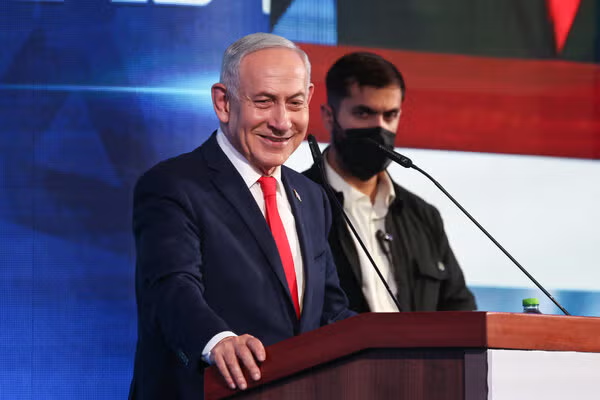

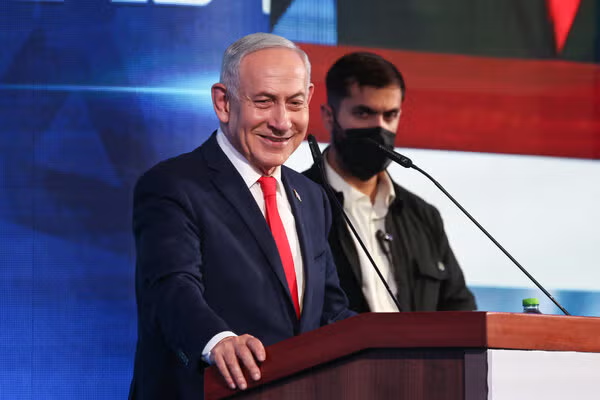
With about 85% of votes counted, Netanyahu’s Likud party and its allies, including far-right and ultra-Orthodox Jewish parties, were projected to win 53 of the 120 seats in Israel’s parliament, known as the Knesset.
Eisenkot’s Yashar party, alongside three other opposition parties, was projected to secure 48 seats.
Neither side appeared close to the 61 seats needed for a parliamentary majority, meaning negotiations with smaller parties could determine who forms the next government.
Arab parties could play a decisive role
Arab-led parties were projected to win 19 seats, giving them a potentially influential position in negotiations over the formation of the next government.
Their support could prove important to either side seeking to secure a parliamentary majority. However, several Jewish parties have previously ruled out working with Arab-led parties, making the path to a coalition more complicated.
Both Netanyahu and Eisenkot are expected to seek support from other political groups as they attempt to gather enough seats to govern.
Final results still pending
Between 430,000 and 480,000 special ballots were still awaiting counting. These included votes cast by soldiers, diplomats and patients in hospitals who could not reach regular polling stations.
The outstanding votes could delay the final results by another day or two.
Once the results are confirmed, President Isaac Herzog will consult political party representatives before deciding which candidate has the best chance of forming a government.
The selected candidate will then be tasked with bringing parties together to secure a majority in parliament, a process that could take several weeks.
If the candidate fails to form a government within the allotted time, Israel could be forced to hold another election, extending the country’s political uncertainty.